
Efficient Inventory Management using Warehouse Racking
At a small logistics site close to Changi, a modest 3PL team executed a meaningful transition. Overnight, they moved from floor block-stacking to a rack layout. That decision opened up aisles, helped improve driver safety, and shortened the time spent locating pallets.
In a few weeks, cycle counts sped up and they deferred expensive floor expansion. It’s a practical option for teams wanting to get more capacity from existing space with racking.
Racking systems are designed to transform cubic warehouse volume into organised storage. They help streamline movement and reliable counts for NTL Storage. Given Singapore’s high land costs, racking is essential for efficient inventory storage.
Racking aims to use space better, ease material movement, and help improve overall efficiency. Advantages: easier access, cleaner aisles with lower fall risk, SKU flexibility, and scalability as inventory evolves.
Successful implementation requires a combination of assessment, design, procurement, and installation. It also involves clear labelling and staff training. This approach ensures that managing inventory with racking systems delivers tangible improvements in warehouse inventory management. It helps defer costly footprint expansion.
Warehouse racking explained and its importance for Singapore operations
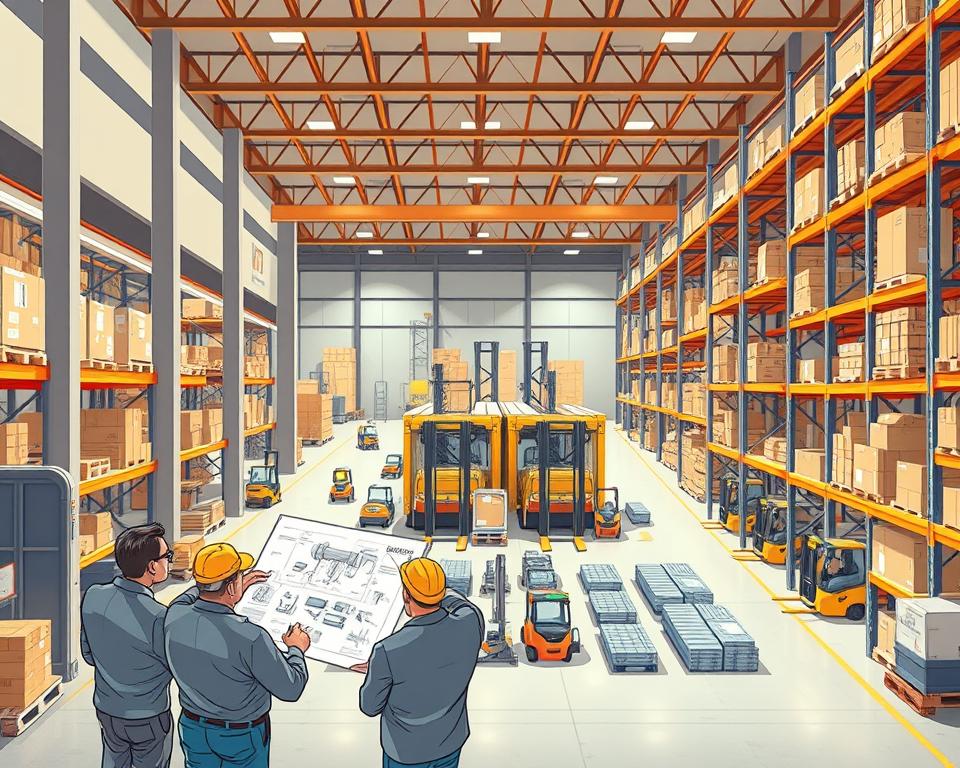
Understanding a warehouse racking system is key for logistics teams to optimize space and flow. It’s a framework of racks and shelves across warehouses, DCs, and industrial sites. It leverages vertical height to organise and store goods efficiently. Well-designed systems help improve picking speed, inventory visibility, and safety.
Core parts and definition
A standard setup includes uprights, beams, wire decks, pallet supports, and more. Together they create bays and beam levels that define locations. Match parts to load types and adjust as needs change.
Racking’s place in modern operations
Fixed locations via racking are critical to efficient inventory control. This makes inventory counts quicker and picking more accurate. Operations often integrate barcode/RFID and WMS to gain real-time oversight. Together they raise throughput and enable varied pick methods, speeding fulfillment.
Relevance to Singapore’s constrained-space environment
In Singapore, maximizing vertical capacity is critical due to limited real-estate and floor area. High-density solutions like drive-in and pallet flow reduce aisle needs and increase storage density. The right mix balances density with selectivity, ensuring efficient use of space without compromising safety.
Choosing the right racking solution for your operation
Selecting the correct rack type is central to efficient operations. This guide explores the impact of rack form on daily operations. It compares common rack types, helps match rack type to inventory, and outlines cost considerations for Singapore warehouses.
Rack types overview
The most widespread option is selective pallet racking. It provides direct aisle access to every pallet position. It fits fast-moving SKUs and adaptable layouts. Expect about $75–$300 per position.
Drive-in/drive-thru racks boost density by allowing trucks to enter lanes. They suit bulk, low-variability storage and cut aisle count. Expect roughly $200–$500 per pallet position.
Cantilever racking uses arms to hold long or odd-shaped items such as lumber and pipes. Front-column-free design eases loading. Typical cost: $150–$450 per arm.
Pushback racking stores multiple pallets per depth on carts or rails. It raises density https://www.ntlstorage.com/racking-system-load-management-guide-safe-and-efficient-storage/ while keeping reasonable access to recent pallets. Costs run $200–$600 per position.
Pallet flow employs sloped rollers to enforce FIFO. It fits perishables and expiry-sensitive SKUs. Expect $150–$400 per pallet location.
AS/RS and robotics span broad cost ranges. They offer high density, speed, and strong integration with warehouse management systems. Pricing hinges on throughput targets, automation scope, and site factors.
How to match racks to your inventory
Evaluate SKU dimensions, weight, turnover, and handling equipment when choosing a rack. For high velocity/mixed SKUs, choose selective or AS/RS with pick access. This enables efficient storage and faster pick cycles.
Large, long, or irregular goods fit cantilever racks. This keeps aisles clear and reduces product handling time. Proper pairing reduces damage while speeding workflows.
For FIFO-sensitive stock (e.g., food, pharma), pallet flow enforces date order. That makes them central to inventory management in regulated categories.
Low-SKU-variability, bulk loads benefit from drive-in, drive-thru, or pushback racks. These options maximise usable space so operators can store more while managing inventory with racking systems designed for density.
Budgeting for racking systems
Budgeting goes beyond unit pricing. List price is just the beginning. Account for labour, anchors, decking, supports, and safety gear. Add engineering, compliance checks, and training time.
Unit guides: selective 75–300, drive-in 200–500, cantilever 150–450/arm, pushback 200–600, flow 150–400, AS/RS varies. Weigh cost factors for NTL Storage with lifecycle expenses.
Factor in floor reinforcement, delivery, and possible downtime during installation. Long-run gains include better space use, quicker picks, and reduced handling damage. These gains often justify higher upfront investment.
| Type | Use Case | Typical Unit Cost | Key Benefit |
|---|---|---|---|
| Selective PR | High-velocity, diverse SKUs | \$75–\$300/position | Direct access to each pallet for fast picks |
| Drive-in/Drive-thru | Bulk storage, low SKU variety | \$200–\$500 each | Fewer aisles, higher density |
| Cantilever | Timber, pipe, long goods | \$150–\$450 each arm | No front columns; easy loading of long items |
| Pushback | Density with reasonable access | \$200–\$600 per pallet position | Multiple pallets deep with simplified retrieval |
| Gravity flow | FIFO-critical items | \$150–\$400 per pallet position | Automatic FIFO for expiry control |
| AS/RS + Robotics | High-volume automation | Highly variable by scope | Dense, fast, WMS-integrated |
managing inventory with racking systems
Fixed rack locations simplify tracking. Allocate precise slots per SKU using master data. This improves inventory control by reducing misplacement and speeding retrieval.
Group SKUs by velocity, size, and compatibility. Designate specific zones for fast-moving items using an A/B/C layout. Position these items at optimal pick-face heights to reduce travel time and increase order pick rates.
Choose rotation methods aligned to lifecycle. For perishables, use flow racks or strict putaway to maintain FIFO. For dense, LIFO-friendly operations, consider pushback or drive-in racking.
Build rack locations into daily control routines. Count by rack, audit slots, and resolve variances. Link count results to the WMS to maintain accurate master records.
Optimize pick paths and staging areas to decrease travel time and handling errors. Ensure rack heights align with forklift reach and operator ergonomics for safe, efficient tasks. Educate staff on load limits, correct pallet placement, beam clipping, and spacing.
Track KPIs tied to racking: picks/hour, putaway time, utilisation, accuracy, and damage rates. Review trends weekly to spot improvements.
Establish clear procedures, provide regular training, and implement simple visual controls to ensure adherence to floor rules. Clarity on limits and placement makes control consistent and measurable.
Design, loading, and installation: best practices
Strong designs start from comprehensive site assessment. It’s essential to gather data on inventory profiles, handling equipment specifications, ceiling heights, column locations, and floor load limits. This initial phase is critical for optimizing warehouse space with racking systems. It ensures safety and operational efficiency.
Planning the layout
Start by mapping SKU velocity using ABC analysis. Locate fast movers near dispatch in accessible zones. Reserve deeper lanes for slower-moving bulk items. Balance aisle widths for safe trucks versus density.
Ensure circulation covers exits, sprinklers, inspection clearance. Bring engineers and trusted vendors in early. That way solutions fit the site and comply locally.
Load capacity and shelving load calculation
Base shelf loads on materials, dimensions, and support spacing. Apply manufacturer load tables plus safety factors. Confirm deflection limits and per-pallet loading.
Check slab capacity for heavy or point loads. Consult engineers on reinforcement or footings if needed. Post clear load postings on each bay and train staff on per-level and per-bay limits. Routine checks prevent overstress on uprights/beams.
Accurate load calcs uphold compliance and mitigate collapse risk.
Procurement and installation checklist
Use a racking procurement checklist to confirm rack type, bay dimensions, finish, and required accessories. Ensure docs include compliance certificates and warranties.
| Phase/Stage | Checklist Items | Stakeholders |
|---|---|---|
| Planning | Inventory profile, aisle widths, fire access, SKU zoning | Warehouse manager, logistics planner, structural engineer |
| Design/Engineering | Load ratings, deflection, slab capacity | Rack vendor engineer, structural engineer |
| Buying | Spec, finish, accessories, certificates | Buyer, vendor rep, safety |
| Installation | Site prep, anchor uprights, secure beams, add decking, wall ties | Certified crew, site lead |
| Verification/QA | Alignment, clips, clearances, signage | Inspector, safety, engineer |
| Post installation | Initial engineering inspection, register with authorities, as-built drawings | Engineer, compliance, maintenance |
Adhere to best practices: level floors, mark bays, anchor uprights, install beams to spec. Fit decking and pallet supports, apply cross-ties and wall ties where required. Check clips and plumb, then post visible capacities.
After installation, provide training on managing inventory with racking systems, safe loading, and damage reporting. Keep records of as-built drawings and inspections to support maintenance and future upgrades.
Organisation, labelling, and tech for inventory control with racking
Organised racks plus consistent labels cut errors and streamline work. Define a clear, unique location ID structure. Ensure the format is intuitive for pickers and aligns with your Warehouse Management System (WMS).
Apply robust barcode/RFID labels at eye level. Include SKU, maximum load capacity, and handling instructions on each label. Standardising label content across the facility enhances inventory control and reduces training time for new employees.
Scanning via barcode/RFID speeds counts and real-time updates. Scanning at putaway and during picking ensures stock levels are accurate. This practice integrates inventory control with warehouse management, reducing discrepancies during audits.
Strategy shapes rack layout. Zone picking assigns areas to teams. Batch picking groups SKUs for multiple orders. Wave picking sequences by dispatch waves. Use PTL/PTL systems for fast movers to help improve efficiency.
Optimise routes and keep fast movers near pack. Create dedicated pick faces and staging lanes for top SKUs. For perishables, choose flow racks to enforce rotation and cut waste.
Measure accuracy, productivity, and travel. Use data to rebalance SKU locations and rack allocations regularly. Frequent micro-adjustments sustain optimisation.
WMS needs location hierarchy down to positions. Set up hierarchies, pick logic, repl rules, and paths. Align WMS pick instructions with the physical rack layout for seamless operation.
Racking plus automation can meaningfully increase throughput. Evaluate AS/RS, shuttles, and AMRs for speed and density. Integrate automation with barcode/RFID and your WMS for accurate and real-time inventory management.
Keeping racks safe, maintained, and compliant
Racking safety begins with clear load limits and physical safeguards. Label each bay with its rated capacity. Fit beam clips, backstop beams, and pallet supports to prevent pallet movement. Ensure aisles are clear and mark emergency egress routes for quick evacuation if needed.
Routine racking maintenance is key to reducing downtime and risk. Do weekly visuals for damage, misalignment, or anchor issues. Schedule professional inspections by qualified engineers and document findings in an inspection log. These records support audits and insurers.
When damage occurs, immediately take affected bays out of service until repairs are done. Secure anchors, restore clips, and renew labels. Formal reports accelerate fixes and reduce recurrence.
Compliance in Singapore requires meeting local safety rules and codes. Reference international standards (e.g., OSHA) where relevant. Teach safe stacking, capacity respect, and reporting. This builds a safety culture that lengthens rack life and supports maintenance/compliance.
Common Questions
Why are racking systems important in Singapore?
A racking system is a structure that expands storage. It uses uprights, beams, and wire decks. It’s crucial in Singapore due to limited space and high costs. It uses space efficiently, postponing expansion and lowering costs.
What components are in a rack system?
The core components include uprights, beams, and wire decks. Together they form a structured storage system. They shape bays and access for safe, efficient storage.
In what ways does racking help inventory management?
Fixed locations from racking help improve control. This leads to better accuracy and reduced stock loss. They also speed order fulfillment and support real-time tracking.
What rack types are commonly used and when should each be chosen?
Selective and drive-in/drive-thru are common. Use selective for access; drive-in for bulk density. Selection depends on SKU profile and handling.
Matching racks to my inventory
Choose based on dimensions, mass, and turns. High-velocity SKUs fit selective. For bulk storage, consider drive-in or pushback systems. Check truck reach and aisle sizing.
How much do different rack types cost?
Costs differ by type and complexity. Selective typically \$75–\$300. Drive-in typically \$200–\$500. Automation varies widely with throughput/integration.
What to plan before installing racks?
Begin by assessing inventory and site constraints. Include velocity and aisle width. Engage structural engineers and racking vendors to ensure compliance and proper installation.
How are load capacities and shelving calculations determined?
Load capacities depend on shelf material and dimensions. Manufacturers provide load tables to guide calculations. Display limits and confirm slab capacity for heavy points.
What should a procurement and installation checklist include?
Confirm type, size, and capacities. Include required accessories and compliance documentation. Follow installation steps and schedule inspections to ensure proper setup.
Organising, labelling, and tech integration?
Use a standardised location code system. Apply durable labels and integrate to WMS. It enables accurate slotting and automated picks.
Best picking strategies for racking?
Use zone picking with selective to boost speed. Use pallet flow for FIFO stock. High-throughput SKUs benefit from automated systems. Design routes to minimise travel.
Balancing density and selectivity?
Balance based on velocity and access. Put fast movers in selective and bulk in dense. Locate fast in selective zones, slow in deep lanes.
What safety and maintenance practices are essential for racking systems?
Post limits and fit safety gear. Schedule routine checks and fix issues. Ensure clear aisles and marked egress. Document all inspections and repairs for audits and insurance.
Compliance considerations in Singapore?
Comply with local workplace safety standards and building codes. Engage engineers and registered vendors. Follow recognised rack safety best practices and keep records for regulatory review.
Racking’s role in control and rotation
Fixed rack locations help improve accuracy. Apply FIFO or putaway rules. Organized zones and clear labels support expiry management for perishables.
Which KPIs to track post-implementation?
Monitor pick rate, putaway, utilisation. Monitor inventory accuracy and pick accuracy. Use metrics to rebalance and gauge ROI.
When to consider AS/RS or robots?
Consider automation with high volume, labour pressure, or tight space. Shuttles and AS/RS provide dense, rapid handling. Evaluate lifecycle costs and integration before committing.
How should we train staff for racking?
Teach limits, correct placement, and reporting. Offer post-install training and refreshers. Promote a culture of prompt impact reporting.
What should be included in recordkeeping and documentation?
Retain as-builts, calculations, and load tables. Keep logs for inspections/maintenance, certificates, and training. These documents support audits, insurance claims, and lifecycle planning.